CSA & ANSI Standards Explained: How Standards Relate to PHSRs in Ontario

When an industrial facility installs or modifies machinery, one of the questions that often comes up during a Pre-Start Health and Safety Review (PHSR) is:
“What standards does the engineer use to determine whether the equipment is safe and compliant?”
The answer can involve several different sources of requirements, including Ontario legislation, regulations, codes, and recognized engineering and safety standards.
Two organizations that frequently appear in industrial equipment discussions are CSA and ANSI.
CSA standards and ANSI standards can provide important technical guidance for the design, safeguarding, operation, and assessment of industrial equipment. However, it is important to understand that a CSA or ANSI standard is not, by itself, the same thing as an Ontario legal requirement.
The standards applicable to a PHSR depend on the equipment, process, hazards, installation, and specific requirements being assessed.
This guide explains the difference between CSA and ANSI standards, how they relate to PHSRs, and why standards matter when evaluating industrial equipment in Ontario.
phsr banner image

What Are CSA Standards?

CSA refers to the Canadian Standards Association, now operating as CSA Group.
CSA Group develops standards covering a wide range of products, systems, equipment, and safety requirements.
For industrial facilities, CSA standards can provide technical requirements and guidance relating to areas such as:
  • Machinery safety
  • Electrical systems
  • Industrial control systems
  • Workplace equipment
  • Hazardous locations
  • Machine safeguarding
  • Electrical installations
  • Fire and safety systems
  • Industrial processes
CSA standards are widely used in Canada and can be particularly relevant when evaluating equipment installed in an Ontario workplace.
The applicable standard depends on what is being assessed.

Contact Us

This field is required.

What Are ANSI Standards?

ANSI stands for the American National Standards Institute.
ANSI is a U.S. organization that coordinates and accredits voluntary consensus standards and standards-development processes.
ANSI itself does not necessarily write every technical standard carrying an ANSI designation. Instead, it plays an important role in coordinating and approving standards developed through accredited organizations.
ANSI standards are widely referenced throughout North America, including in industrial machinery and workplace safety.
For equipment that is manufactured in or designed for the United States, ANSI standards can be particularly relevant.

CSA vs. ANSI: What Is the Difference?

The simplest distinction is:
CSA is associated primarily with Canadian standards, while ANSI is associated with the U.S. standards system.
However, the relationship is more complicated than simply “Canadian standards versus American standards.”
Many industrial standards are developed collaboratively, harmonized, or adopted across jurisdictions.
Equipment manufacturers may also design machinery to multiple standards.
For example, an industrial machine sold in both Canada and the United States may have been designed with both Canadian and American requirements in mind.
The engineer conducting a PHSR needs to determine which requirements and standards are relevant to the particular equipment and installation.

Are CSA and ANSI Standards Law?

Not automatically.
This is one of the most important distinctions to understand.
A standard is not necessarily a law simply because it has a CSA or ANSI designation.
A PHSR must consider the applicable Ontario legal and regulatory requirements. Technical standards may then be used as part of the engineering assessment where they are relevant to the equipment, hazard, or design.
In other words:
Legislation establishes legal requirements. Standards can provide technical requirements, specifications, and recognized methods for addressing safety and engineering issues.
The relationship between the two can vary depending on the specific standard and legal context.
This is why simply telling an employer that equipment is “CSA compliant” does not necessarily answer every PHSR question.

Contact Us

This field is required.

What Role Do Standards Play in a PHSR?

A PHSR is an engineering assessment.
The engineer must determine which requirements apply to the equipment being reviewed and assess the installation accordingly.
Depending on the project, this can involve consideration of:
  • Ontario occupational health and safety requirements
  • Applicable regulations
  • CSA standards
  • ANSI standards
  • NFPA standards
  • Other recognized engineering standards
  • Equipment manufacturer requirements
  • Project-specific requirements
The exact combination depends on the equipment and hazards.
For example, a PHSR for a conventional machine may involve significant consideration of machine safeguarding and safety controls.
A PHSR involving combustible dust may require additional consideration of fire and explosion hazards and applicable standards.
An electrical component of an industrial installation may involve different standards from the mechanical equipment itself.

Why Are Standards Important for Industrial Equipment?

Industrial equipment can present complex hazards.
A machine may contain:
  • Moving mechanical components
  • Electrical systems
  • Pneumatic systems
  • Hydraulic systems
  • Automated controls
  • Stored energy
  • Hot surfaces
  • Cutting or crushing hazards
  • Hazardous materials
  • Combustible materials
Standards can provide established technical approaches for addressing these types of hazards.
They can help engineers, manufacturers, integrators, contractors, and employers understand accepted approaches to equipment design and safety.
However, standards should be applied in the context of the actual installation rather than treated as a generic checklist.

storage racking systems

Machine Safeguarding Standards

Machine safeguarding is an important part of many PHSRs.
Safeguarding can include:
  • Fixed guards
  • Interlocked guards
  • Safety switches
  • Light curtains
  • Presence-sensing devices
  • Safety mats
  • Barriers
  • Emergency stops
  • Other protective devices
The appropriate safeguarding depends on the equipment and hazard.
Relevant CSA or ANSI standards may provide technical guidance for evaluating these systems.
During a PHSR, the engineer may consider whether the safeguarding adequately addresses the hazards associated with the equipment and how workers interact with it.

Contact Us

This field is required.

Electrical Standards and PHSRs

Industrial equipment frequently includes electrical power and control systems.
Depending on the project, electrical standards may be relevant to:
  • Power distribution
  • Wiring
  • Control panels
  • Disconnects
  • Grounding
  • Motor controls
  • Safety circuits
  • Hazardous locations
  • Emergency power
  • Equipment connections
CSA standards are particularly relevant to many Canadian electrical and equipment applications.
The specific standard depends on the equipment and installation.
An electrical assessment should therefore be coordinated with the overall PHSR where electrical systems form part of the equipment’s safety or operation.

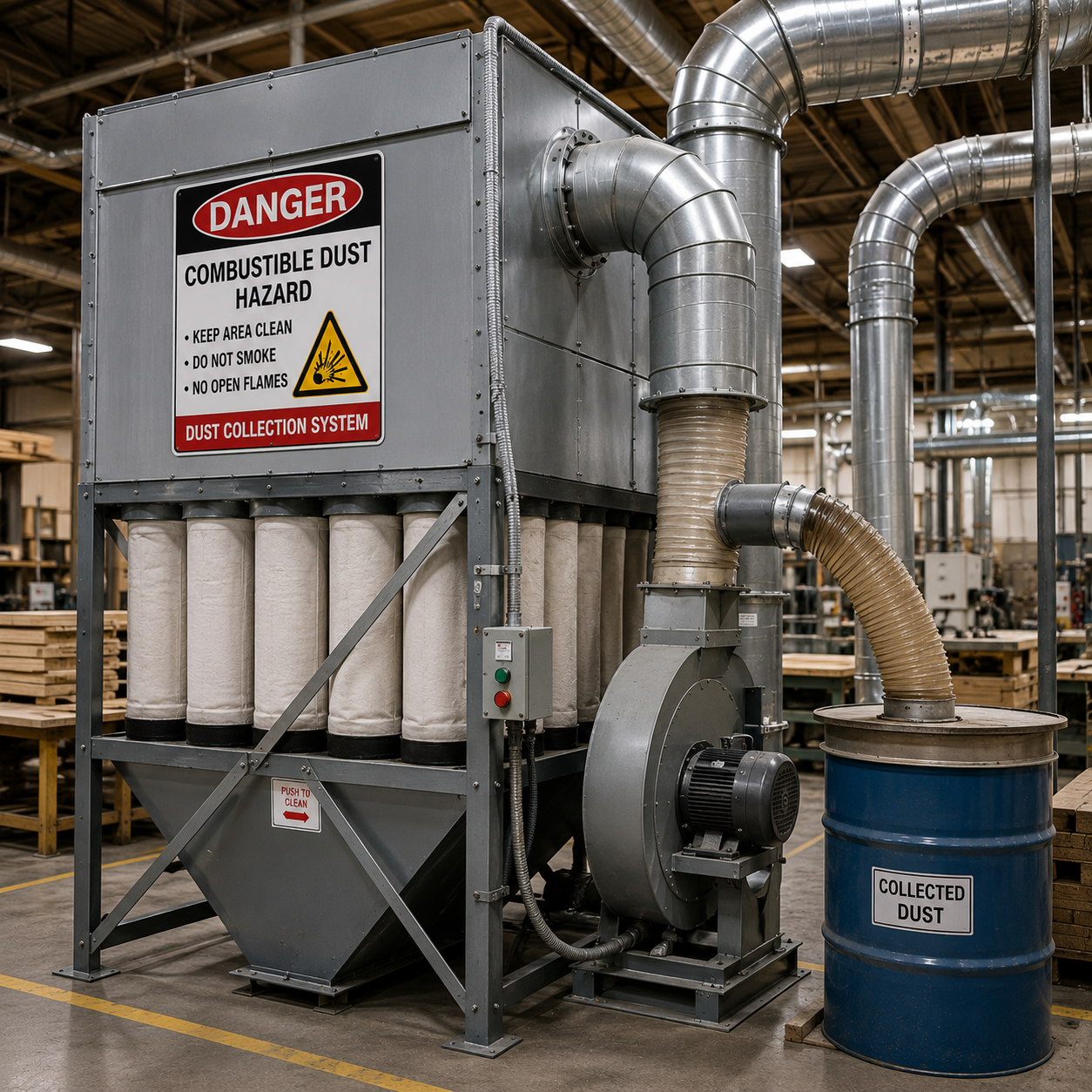
CSA, ANSI and Combustible Dust

Combustible dust presents a particularly important example of why multiple standards may need to be considered.
Industrial facilities may generate combustible dust from:

  • Wood
  • Grain
  • Food products
  • Agricultural materials
  • Chemicals
  • Pharmaceuticals
  • Certain metals

A dust collection or processing system can involve hazards associated with fire, deflagration, explosion, and explosion propagation.
Depending on the installation, engineering consideration may include:

  • Dust collection equipment
  • Ductwork
  • Explosion venting
  • Explosion suppression
  • Explosion isolation
  • Ignition-source control
  • Electrical equipment
  • System integration
  • Process hazards

CSA and ANSI Standards for Automated Equipment

Automation creates additional safety considerations. A production system may contain:
Machine → Conveyor → Robot → Processing Station → Conveyor → Packaging Equipment
Each individual component may have safety features, but the complete system needs to function safely when integrated. Standards may be relevant to:
  • Safety-related controls
  • Interlocking
  • Protective devices
  • Emergency stops
  • Restricted access
  • Automated movement
  • Restart prevention
  • Operator interaction
  • Control-system architecture
The PHSR can therefore involve evaluating both individual machines and the integrated system.

Does ANSI Certification Mean a Machine Is Compliant in Ontario?

Not necessarily.
A machine designed or certified according to an American standard may provide useful documentation and evidence of engineering compliance with that standard.

However, Ontario has its own workplace health and safety requirements.
The equipment must be evaluated in the context of the requirements applicable to its Ontario installation.

This is particularly important for imported equipment.

Imported Equipment and International Standards

Ontario manufacturers and industrial facilities frequently purchase equipment from outside Canada.
Imported equipment may have been designed according to:
  • ANSI standards
  • European standards
  • IEC standards
  • ISO standards
  • Other national or international standards
These standards can provide useful engineering information.
However, an employer should not assume that compliance with another jurisdiction’s standards automatically establishes compliance with Ontario requirements.
A PHSR engineer can review the available documentation and determine which additional requirements need to be considered.

Contact Us

This field is required.

Does CSA Certification Mean a PHSR Is Not Required?

No.
CSA certification and PHSR requirements address different questions.
A product may have been certified or evaluated against a particular CSA standard, but that does not automatically determine whether a PHSR is required for its installation in an Ontario workplace.
The workplace installation may introduce additional considerations. For example, equipment may be:
  • Connected to other machinery
  • Modified after manufacture
  • Installed in a different environment
  • Integrated into an automated production line
  • Connected to new controls
  • Used with different materials
These circumstances can affect the engineering assessment.

What Standards Should Be Used for a PHSR?

There is no single list of standards that applies to every PHSR.
The appropriate standards depend on factors such as:

Equipment type

Industry

Process

Hazards

Machine design

Materials

Controls

Electrical systems

Installation environment

Equipment modifications

Applicable Ontario requirements

For that reason, a competent PHSR should begin with identifying the requirements applicable to the specific project, rather than selecting a generic standards checklist.

How an Engineer Uses Standards During a PHSR

A simplified example of the process might look like this:
phsr services

Identify the equipment

What machine, process, or system is being assessed?

Identify the hazards

What could cause injury, fire, explosion, electrical exposure, or another workplace hazard?

Identify applicable requirements

Which Ontario regulatory requirements apply?

Identify relevant standards

Which CSA, ANSI, NFPA, or other standards are relevant to the equipment and hazards?

Assess the installation

Does the actual equipment and installation satisfy the applicable requirements?

Document findings

Any deficiencies or recommendations are documented as part of the engineering assessment.

Address deficiencies

Where required, corrective actions are implemented and reviewed.

Complete the PHSR

The applicable engineering documentation is finalized once the required assessment and corrective actions are complete.

What Is the Difference Between a PHSR and a Standards Assessment?

A PHSR and a general standards assessment are not necessarily the same thing.
A PHSR is performed for the purpose of addressing the applicable pre-start health and safety requirements for the equipment or process within its defined scope.
A standards assessment may have a different purpose, such as determining whether equipment has been designed or constructed according to a particular technical standard.
Standards can form part of a PHSR, but a PHSR should not simply be described as a generic “CSA inspection” or “ANSI inspection.”
The engineer determines what requirements and standards are relevant to the specific review.

Contact Us

This field is required.

What Documentation Should Equipment Manufacturers Provide?

When equipment is being purchased for an Ontario facility, manufacturers can help by providing as much technical information as possible.
Useful documentation can include:

Equipment manuals

Technical specifications

Engineering drawings

Electrical schematics

Control-system documentation

Safety-system information

Guarding information

Certification documentation

Applicable standards

Testing information

Installation requirements

Maintenance requirements

Providing this information to the PHSR engineer can make the assessment more efficient.
It can also help identify potential issues before the equipment arrives at the facility.

What If Multiple Standards Apply?

It is common for complex industrial projects to involve multiple standards.
For example, an automated production line could involve requirements relating to:
  • Machinery
  • Electrical systems
  • Controls
  • Safeguarding
  • Conveyors
  • Robotics
  • Fire protection
  • Combustible dust
The engineer needs to determine how the applicable requirements interact.
This is one reason experience with multidisciplinary industrial systems is valuable during a PHSR.
The goal is not simply to identify as many standards as possible. The goal is to identify and apply the standards and requirements relevant to the actual equipment and hazards.
industries we serve

PHSR Engineering Experience from Wintek

PHSR.com is supported by Wintek Engineering, an established engineering company with a history dating back to 1994.
Wintek's broader industrial engineering experience includes PHSRs as well as areas such as dust collection, explosion protection, equipment integration, and related industrial engineering services.
That multidisciplinary perspective is valuable when a PHSR involves more than a standalone machine.
For example, a dust collection system may require consideration of both the equipment itself and the surrounding process, controls, explosion protection, and material being handled.
The same principle applies to automated production lines, integrated machinery, and other complex industrial systems.

FAQs About CSA & ANSI Standards

CSA refers to the Canadian Standards Association, now operating as CSA Group. CSA Group develops standards covering many Canadian products, systems, equipment, and safety applications.
ANSI stands for the American National Standards Institute. ANSI coordinates and accredits standards-development processes and is associated with many widely used U.S. standards.
Not automatically. Whether a particular standard is mandatory depends on the applicable legal, regulatory, contractual, certification, or other requirements.
Not automatically. ANSI standards may be relevant to industrial equipment, particularly equipment designed for the U.S. market, but the applicable Ontario requirements must also be considered.
A PHSR may consider relevant CSA standards where applicable to the equipment, installation, or hazards being assessed.
ANSI standards may also be relevant depending on the equipment and project.
No. CSA certification and a PHSR serve different purposes. A CSA certification does not automatically eliminate the need to determine whether a PHSR is required.
No. Compliance with an American standard does not automatically establish compliance with every Ontario workplace requirement.
The applicable standards depend on the equipment, process, hazards, installation, and regulatory requirements. A qualified engineer can identify the standards relevant to the specific project.
Yes. Standards can be revised, updated, replaced, or superseded. The applicable edition should be confirmed for the project being assessed.

Why Standards Knowledge Matters in a PHSR
A PHSR is ultimately about more than checking whether a machine has a particular certification label.
Industrial equipment needs to be evaluated in the context of its actual workplace installation, operation, hazards, and applicable requirements.
Understanding CSA, ANSI, and other standards allows the engineer to make a more informed assessment and identify where equipment or systems may require changes.
For employers, this can provide greater confidence that potential issues are being identified before equipment is put into service.
For equipment manufacturers and integrators, understanding the standards that may apply to Ontario installations can also help make the PHSR process more efficient.
dust collection systems

Need Help Determining Which Standards Apply?

You do not need to determine the applicable CSA or ANSI standards on your own before contacting a PHSR engineer.
If you are planning to install or modify industrial equipment in Ontario, provide the basic project information available to you.
Useful information includes:
  • Equipment type
  • Manufacturer
  • Project location
  • Intended use
  • Process description
  • Available drawings
  • Existing certification or standards documentation
  • Details of any modifications
PHSR.com can review the project requirements and help determine the appropriate engineering next step.
Scroll to Top